 XRメモランダム
 A thought experiment: what if the VTuber industry borrowed the player-transfer model from professional sports?
This article explores a hypothetical solution to one of the most discussed issues in the VTuber business: graduation and reincarnation. Specifically, it asks whether a transfer-fee system similar to those used in professional sports could help VTubers continue their careers without abandoning their names and avatars.
● This is a speculative / thought-experiment article, not a proposal based on insider knowledge.
● The article may be revised and expanded after publication; some sections are intentionally exploratory rather than exhaustive.
● Examples from European professional football (soccer) appear later as an analogy and are not explained in full detail.
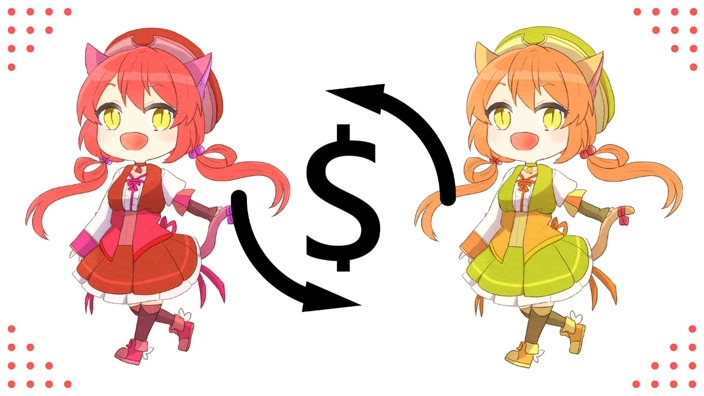
Table of Contents
What is the VTuber “graduation and reincarnation” problem?
In recent years, more corporate-affiliated VTubers have left their agencies (“graduated”) due to personal decisions, disagreements over direction, or other circumstances.
When those VTubers resume activity independently, they usually do so under a new name and new visual identity — a process fans commonly call reincarnation(転生).
The reason is straightforward: in most cases, the agency owns the IP associated with the VTuber’s existing name, design, and 2D/3D avatar.
The benefits and drawbacks of “reincarnation”
When a corporate VTuber graduates and reincarnates as an independent, the VTuber themselves faces these pros and cons:
| Pros | Cons |
|---|---|
| – Changing name and appearance can reset or refresh the character image. – Becoming a “different person” can free the creator from rules associated with the former agency identity. | – The performer’s public career appears interrupted because the existing identity cannot be carried over. – Some existing fans may not follow the new identity. – Even when fans quickly identify the performer, everyone typically pretends it is a brand-new debut, creating an awkward “we all know, but we don’t say it” ritual. [*1] |
[1] In VTuber fandom, if a previous identity is widely known, the customary behavior is still to greet the reincarnated VTuber as a brand-new newcomer. Bringing up the previous identity directly in the new VTuber’s chat or debut context is generally treated as bad etiquette.
From the company’s perspective, a graduation is obviously the loss of a revenue-generating talent.
Agencies may still own the departed VTuber’s IP, but in practice the character is often inseparable from the performer’s personality. As a result, replacing the performer and relaunching the character, or continuing to sell related content indefinitely, is uncommon and usually struggles. [*2]
In many cases, the retained IP ends up being used mainly for limited reprints of older merchandise rather than active character operations — effectively an underutilized asset. [*3]
[2] Such cases are not literally nonexistent, but most have faced significant challenges.
[3] Retaining IP still has value for preventing unauthorized use. Also, some agencies have introduced statuses that allow limited post-graduation appearances at anniversary or commemorative events.
Current workarounds that already exist
There are already several ways a VTuber can continue using their name and avatar after leaving an agency.
- The individual buys back the IP.
- The VTuber moves between companies by mutual agreement.
- The agency shuts down and transfers the IP to the performer for free or at a low price.
- The agency gave the IP to the performer from the start.
1. Buying back the IP personally
Well-known examples include Suou Patra(周防パトラ) and Kujo Ringo(九条林檎). Both publicly stated that they acquired the rights to their names and character identities when becoming independent.

Outside Japan, Daiya Fortuna reported purchasing her IP when the agency PixelLink closed, and also noted receiving support from Zentreya during the process.
2. Company-to-company transfers
Examples include Amagasaki Eko(雨ヶ崎笑虹) moving from AVATAR2.0 Project to Palette Project, and Komori Met(小森めと, pronounced “Komori Meto”) moving from 774 inc. (now Nanashi inc.) to VSPO!. Whether any transfer fee or equivalent payment was involved has not been publicly disclosed.
Another notable case: in December 2025, Syusetu Kohaku joined the professional esports team REJECT directly from VEE without a lengthy hiatus. The terms were not public, and because she had also begun operating as an independent VTuber, it is possible she already controlled her IP.

3. IP transferred after an agency shutdown
This is a special case, but when an agency shuts down, IP is sometimes transferred to the performer for free or cheap [*4] [*5]. A well-known example is Kaminari Qpi(神成きゅぴ), now with VSPO! (former agency dissolved → indie → joined VSPO!).
While I say “free,” money may still change hands. That said, we don’t see stories of “I couldn’t afford to take my IP,” so if there is a cost, it’s likely within what an individual can pay.
[4] I call it special, but VTuber agency shutdowns are actually fairly common.
[5] Though it didn’t directly affect character IP transfers, the July 2025 dissolution of US VTuber agency VShojo is worth remembering as a related event.
4. Agencies that grant IP to performers from day one
V-Sen(ぶいせん), a VTuber agency founded by Nori , who operates the motion-capture studio Kimassi Studio and is known for the Asano Sisters Project (Asano Ruri and Asano Akane), adopted a model in which performers received the full package of IP rights — including their 2D avatars — free of charge when they joined the agency.
V-Sen debuted a total of 11 VTubers, including those who later retired, went independent, or transferred to other organizations. But as a very unusual agency model, it hasn’t consistently produced new talent.
For reference, Hananoki Maru(花ノ木まる), who graduated V-sen in November 2022 and went indie, joined Uniraid!, a VTuber project run by Brave group subsidiary ENILIS, in April 2024.
What is a transfer-fee system in professional sports?
Now, finally, let’s talk transfer fees.
In many professional sports, especially European football (soccer), a player moving under contract typically involves a transfer fee (sometimes framed as a buyout or contract-release payment). This money is paid between clubs and is separate from the player’s salary at the new club.
At the highest levels of European football, transfer fees are often several to dozens of times larger than a player’s annual salary. Fees above €100 million are no longer unprecedented.
What if VTubers had transfer fees?
What could happen if this system were brought into VTubing?
VTubers could keep their names and avatars
The most obvious consequence would be continuity. If a transfer were agreed, the VTuber could continue operating under the same name and visual identity without personally paying a massive buyout.
Today, only a small number of creators can realistically afford to repurchase valuable IP themselves. A transfer fee paid by a company or investor could remove that financial burden while preserving the audience-facing identity.
Money would matter more in agency competition
Large agencies — or well-funded newcomers — could acquire talent from smaller agencies by paying for the rights.
That sounds negative at first, but the sports analogy suggests another possibility: a “step-up transfer.” A VTuber could move to an organization with better resources, larger events, higher compensation, or a direction that better matches their goals. The move of Komori Met is often cited as a case where the new environment aligned more closely with the talent’s aspirations.
Talent-development agencies could emerge
If transfer fees became standard, some agencies might specialize in discovering, developing, and later transferring talent for profit.
Using a football analogy, this would resemble clubs that routinely develop players and sell them to bigger clubs. In VTuber terms, a creator could debut at a small agency, grow there, and later move to a major organization such as hololive Production or Nijisanji.
Not a corporate transfer, but indie VTuber Yumeno Akari(夢野あかり) joining VSPO! — considered the third-largest domestic VTuber agency — is close to that image.
One more: we could see VTuber agencies that excel at “buy low, develop, sell high,” assuming a transfer fee system. In recent Premier League terms, think Brighton and Chelsea…. [*6]
[6] Brighton & Hove Albion F.C. is often praised for player development and profitable transfers, while Chelsea F.C. has repeatedly paid large fees for Brighton players and staff, leading to jokes that “Chelsea is Brighton’s best customer.”
Why the system might not fit the current VTuber industry yet
The transfer-fee idea sounds attractive on paper, but several obstacles stand out.
- There is no accepted method for valuing a VTuber transfer fee.
- Agency strategies are not differentiated enough.
- VTuber content itself is not differentiated enough.
1. Valuation is hard
A realistic transfer fee would depend on current ability, popularity, revenue generation, growth potential, and remaining contract length. No industry-wide framework exists today.
In practice, a “market rate” would probably emerge only after many transfer cases accumulated, just as sports markets evolved through repeated transactions.
2. Agencies still look too similar
Outside of a few specialized examples — such as VSPO! focusing heavily on esports, or Aogiri High School leaning into boundary-pushing comedy — most major agencies currently appear to offer broadly similar mixes of streaming, music, events, and merchandise.
Unlike sports clubs, VTuber agencies are not primarily competing to win a league table. The industry has generally grown through cooperation and ecosystem expansion. That weakens the need for aggressive talent trading as a competitive weapon.
If transfers become common, the main motivations are likely to be better treatment, better resources, and better alignment with the creator’s goals — which means agencies would need much clearer identities and strategic differences.
3. Many VTubers still compete in the same content lanes
On the creator side, gaming streams, chatting streams, and music remain the dominant formats. Truly distinctive content exists, but it is still relatively uncommon.
A VTuber who wants a completely unique creative direction may find independent status more suitable than agency affiliation. To become a talent that another agency would pay a transfer fee for, a VTuber would need to demonstrate exceptional differentiation while still operating within an agency framework.
Conclusion
For now, the conclusion is: “Keep a transfer fee system in mind, but both agencies and VTubers need to keep diversifying their content and policies and raising quality so the system can actually work.”
A recent case worth watching
One development that hints at a more flexible talent market is Specialite (すぺしゃりて, operated by REALITY Studios, a GREE subsidiary), which launched an ongoing talent audition in March 2025 that explicitly accepted applicants joining from outside organizations.
In October 2025, Anshinin Misa(安心院みさ) joined Specialite through that audition after spending roughly half a year as an independent VTuber. Technically it was not a direct transfer, but from the standpoint of IP continuity it can be read as a positive signal.
Further reading / context
Taiki Iwanaga, former COO of ANYCOLOR (formerly Ichikara), posted an X article in May 2026 titled “Reasons VTubers Graduate and Reincarnate.” The article covers reasons for graduation/reincarnation, plus the “various problems and challenges around rights transfers” that aren’t visible from outside.
Independent VTuber DiscoTei Meteo(禰好亭めてお) published a similar discussion in June 2026, covering many of the same concerns.
Elsewhere, Japan’s Monolith Law Office has published an explainer on VTuber IP buyouts and business transfers, and overseas law firms have also taken up the issue. Check them out if you’re interested.

Disclosure: This article was written by the author based on original research and analysis. ChatGPT and Meta AI were used to assist with editing, organization, and English-language refinement.